
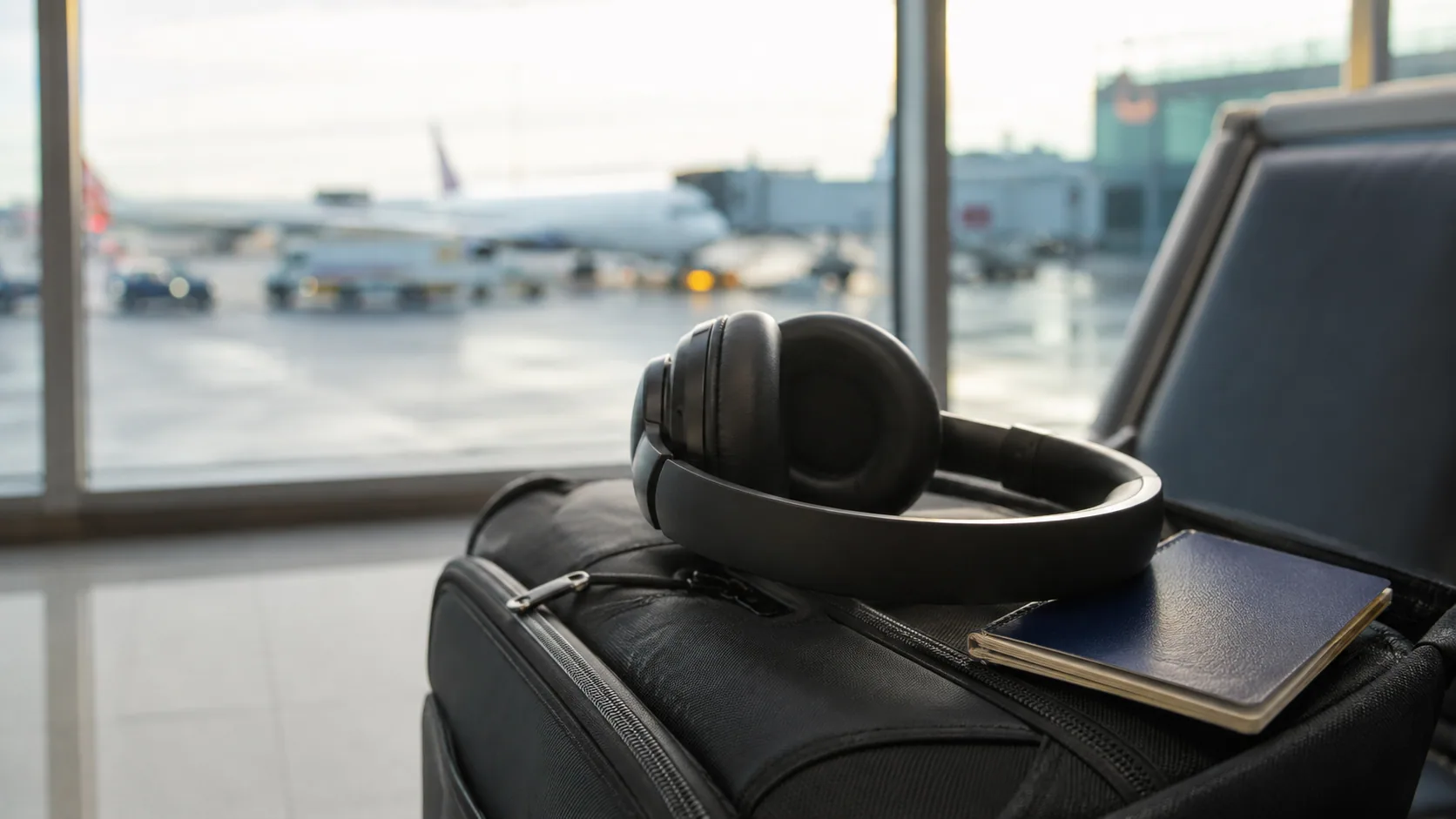
The headphones that fail you are always the ones you grabbed cheap on the way to the gate. The battery dies somewhere over the ocean, the case cracks in an overhead bin, or the noise cancelling turns out to be a sticker rather than a feature, and the engine drone grinds at you for nine hours. Travel is the harshest test a pair of headphones faces, and most are not built for it.
A travel pair has to clear three bars. It needs enough battery to outlast a long-haul flight with room to spare, it needs noise cancelling that actually fights the low engine roar, and it has to survive being shoved into a bag and yanked out a dozen times a trip. There is a quiet fourth bar too: the price has to be one you can stomach losing, because travel is exactly where headphones go missing. The five below are ranked with all four in mind.
- Products analyzed
- 5
- Average rating
- 4.5
- Price range
- budget to premium
- Top rated
- Soundcore Q20i (4.6)
- Most reviewed
- Soundcore Q20i
Our Top Pick
Best for most travelers: the Soundcore Q20i. Battery to cover a long round trip without charging, noise cancelling that knocks down engine drone, app control for switching between films and music, and a price you can risk losing.
Match the pair to the kind of trip
How often you fly should decide most of this. A few trips a year? The Soundcore Q20i is the smart pick, with battery that clears a long round trip on one charge and a price that does not ruin the holiday if it vanishes from a seat-back pocket. Weekly flights and calls you have to take from loud terminals? The Sony is the pair that earns its keep, with deeper quiet and far better call clarity. Already own a good pair and just want a spare for the carry-on? The KVIDIO is cheap and long-lasting enough to be exactly that.
The last two cover narrower needs. The JLab makes sense if you want over-ear cans for the flight and earbuds for moving around the cabin, bought together. The Life Q20 is the Q20i's near-twin, worth a look only if it is cheaper on the day you order.
At a Glance
| Product | Check |
|---|---|
| Soundcore by Anker Q20i Hybrid Active Noise Cancelling Headphones, Wireless Over-Ear Bluetooth, 40H Long ANC Playtime, Hi-Res Audio, Big Bass, Customize via an App, Transparency Mode | (opens on Amazon) |
| Sony WH-1000XM5 Premium Noise Canceling Headphones, Auto NC Optimizer, 30-Hour Battery, Alexa Voice Control, Black | (opens on Amazon) |
| KVIDIO Active Noise Cancelling Headphones, 70 Hours Playtime Bluetooth Headphones Wireless with Microphone, Transparency Mode, Deep Bass and Hi-Fi Stereo Sound Over Ear for Travel Office | (opens on Amazon) |
| JLab JBuds Lux ANC, Over Ear Headphones, Active Noise Cancelling, Bluetooth, Mauve | (opens on Amazon) |
| Soundcore Anker Life Q20 Hybrid Active Noise Cancelling Headphones, Wireless Over Ear Bluetooth Headphones, 60H Playtime, Hi-Res Audio, Deep Bass, Foam Ear Cups, Travel, Office, USB-C Charging | (opens on Amazon) |
The five, ranked for the road
Soundcore by Anker Q20i Hybrid Active Noise Cancelling Headphones, Wireless Over-Ear Bluetooth, 40H Long ANC Playtime, Hi-Res Audio, Big Bass, Customize via an App, Transparency Mode
The Q20i is the travel default, and the reasons are practical rather than glamorous. Its battery comfortably outlasts a long-haul round trip, so you are not hunting for an outlet during a layover, and a few minutes on the cable at the gate buys you hours if you forgot to charge overnight. The noise cancelling handles the steady engine and cabin roar that wears you down on a long flight, and the app lets you flip between a film profile and a music one in a couple of taps. Pairing with two devices at once means the phone stays connected for boarding calls while the tablet plays a movie.
It is plastic where the flagship is metal, and the soft pouch is not a crush-proof case. But at its price, the real travel advantage is that losing it is an annoyance rather than a disaster. The one thing to know is that the cable disables the noise cancelling, so on planes you will want to stay wireless.
Skip this if you fly most weeks and take calls you cannot afford to have garbled. The next pick is built for that life.
Pros
- Battery covers a long round trip on a single charge
- Quick gate-side top-up from a short time on the cable
- Pairs with phone and tablet at once
- Cheap enough that losing it is no catastrophe
Cons
- The cable shuts off noise cancelling, so fly wireless
- Soft pouch rather than a hard travel case
Sony WH-1000XM5 Premium Noise Canceling Headphones, Auto NC Optimizer, 30-Hour Battery, Alexa Voice Control, Black
The Sony is the pair for someone whose calendar is mostly airports. Its noise cancelling goes a meaningful step past the rest, turning a droning cabin into something close to quiet, which over a long flight is the difference between landing frazzled and landing fine. It is also far and away the best here for calls, lifting your voice cleanly out of a chaotic terminal so a layover work call does not become an apology. On a phone that supports it, the wireless sound is the richest on the list.
Its owner rating sits a little under the cheaper picks, which reflects the high expectations a flagship price sets more than any flaw. The case for buying it is honest and specific: if you travel often and depend on those calls, the deeper quiet and the call quality are worth it. The catch is the same price working against you, because this is a pair you would genuinely hate to lose.
Skip this if you fly only a couple of times a year. You would carry a flagship price through every security tray for an edge you rarely meet.
Pros
- The deepest noise cancelling for long flights
- Clearly the best call clarity in loud terminals
- The richest wireless sound here, with the right phone
- Softer clamp for comfort across a long-haul
Cons
- A pair you would hate to lose at the price
- Owner rating runs a touch below the budget picks
KVIDIO Active Noise Cancelling Headphones, 70 Hours Playtime Bluetooth Headphones Wireless with Microphone, Transparency Mode, Deep Bass and Hi-Fi Stereo Sound Over Ear for Travel Office
The KVIDIO makes the most sense as a second pair. It is cheap, it has the longest battery of anything here by a clear margin, useful across a two-week trip where charging is an afterthought, and it folds down small enough to live in a side pocket. The noise cancelling is real and takes the edge off engine drone, not to the flagship's level, but well clear of having nothing at all.
There is no app, so the bass-forward sound is fixed, and the build feels like its price, so plan on a couple of years rather than many. For travelers who already own premium headphones and want a spare they will not cry over, or for someone taking one or two trips a year who wants to try noise cancelling cheaply, it fits the bag and the budget.
Pros
- The longest battery on the list, easily a whole trip
- Folds down small for a carry-on pocket
- Real noise cancelling at the lowest price here
- Light enough to forget you packed it
Cons
- No app, so the sound is what it is
- Lighter-duty build and hinges
JLab JBuds Lux ANC, Over Ear Headphones, Active Noise Cancelling, Bluetooth, Mauve
The JLab sits near the Q20i on price and rating, so on its own it is not the obvious travel upgrade. Its pitch is the bundle: this listing can pair the over-ear cans with a set of true wireless earbuds at one price. On a trip that is genuinely useful, the big cans for the flight itself, the earbuds for wandering the cabin, a beverage run, or a quick walk at a layover without lugging the headphones along. Its app tunes for film, music, and calls, and the noise cancelling is solid if short of the flagship's depth.
For over-ear only, the Q20i covers the same flight duty for less. For a traveler who has been meaning to add earbuds anyway, getting both shapes in one purchase is the efficient move.
Pros
- Over-ear plus true wireless earbuds in one purchase
- A rating right alongside the popular Q20i
- App tuning for film, music, and calls
- Folds neatly into a travel case
Cons
- No flight advantage over the cheaper Q20i on its own
- Noise cancelling does not reach the flagship's depth
Soundcore Anker Life Q20 Hybrid Active Noise Cancelling Headphones, Wireless Over Ear Bluetooth Headphones, 60H Playtime, Hi-Res Audio, Deep Bass, Foam Ear Cups, Travel, Office, USB-C Charging
The Life Q20 is the Q20i's older sibling, and for travel the two are interchangeable in every way that counts: the same long battery, the same noise cancelling, the same comfort, the same accessories in the box. The differences, an older wireless standard and a warmer default sound, do not change a single thing about how it performs at altitude.
So treat this as a price-and-availability call. If the Life Q20 turns up cheaper or in the color you want on the day you are buying, take it and pack it without a second thought. If the two cost the same, the marginally newer Q20i is the tidier default. Either one is a perfectly good flight companion.
Pros
- The same long battery and quick top-up as the Q20i
- Identical noise cancelling and comfort for flights
- Takes a wired connection and charges over the common cable
- Often available cheaper or in more colors
Cons
- Older wireless standard than its twin
- No travel advantage over the Q20i at equal prices
The trade-off that matters in the air
For travel the spending question is sharper than it is at home, because the flagship's strengths are exactly the ones a frequent flyer leans on. Its deeper quiet and its call clarity are most valuable precisely where travel puts you, in loud cabins and chaotic terminals. So if your life is mostly flights and calls, that is the rare case where paying up is genuinely the right move.
For everyone else, the budget and mid picks win on the unglamorous travel virtues. They already outlast the flagship between charges, they knock down the drone that matters most, and they cost little enough that a lost pair is a shrug, not a ruined trip. The deciding factor is not which sounds best in a quiet room. It is how many hostile environments your year actually contains.
Getting through the flight
Whatever you carry, a little prep saves the trip. Charge the night before any flight over a few hours, and pack the cable that fits, since all the picks here charge over the same common connector. Use the case or pouch rather than letting the cans rattle loose in a bag, and avoid winding the cord tight around the hinges, which is what cracks them over time. On older planes with only a headphone jack, remember a small wireless-to-jack adapter, and keep in mind that the cable shuts off noise cancelling on the Soundcore pairs, so wireless is the way to fly.
How much battery do I need for long flights?
Enough to clear a round trip with layovers and a few films on a single charge, which the budget and mid picks here do comfortably. The flagship lasts a little less but still covers most international trips with one top-up along the way. Charging the night before any long flight is the simplest insurance.
Do I really need noise cancelling for travel, or is regular Bluetooth fine?
Noise cancelling is the upgrade that matters most in the air. Ordinary headphones cannot fight the low engine drone of a cabin, while every pick here knocks a good chunk of it down. Over a long flight that is the difference between arriving worn out and arriving fine.
Can these connect to the screen in the seat-back?
On newer planes with wireless entertainment, yes. On older planes with only a headphone jack, you need a small wireless-to-jack adapter, bought separately. Note that using the cable turns off noise cancelling on the Soundcore pairs, so wireless is preferable when it is available.
What price tier suits an occasional traveler?
For a couple of trips a year, the budget or mid picks are plenty. The Q20i is the all-round default and the KVIDIO is the low-cost option or backup. Spending up to the flagship really only pays off if travel is a weekly part of your life.
How do I keep travel headphones from getting wrecked in a bag?
Use the included case or pouch, and add a harder case for the pairs that ship with only soft protection. Do not wrap the charging cable tightly around the ear-cup hinges, since that pressure is what cracks the plastic over time. A little care here is what gets a pair through years of trips.